Terra: Engineering a Faster, Denser Future for Cultivated Cellulose
- Published on
- August 25, 2025
Inside Piedras Pintas Biofoundry’s published new patent and the team behind it.
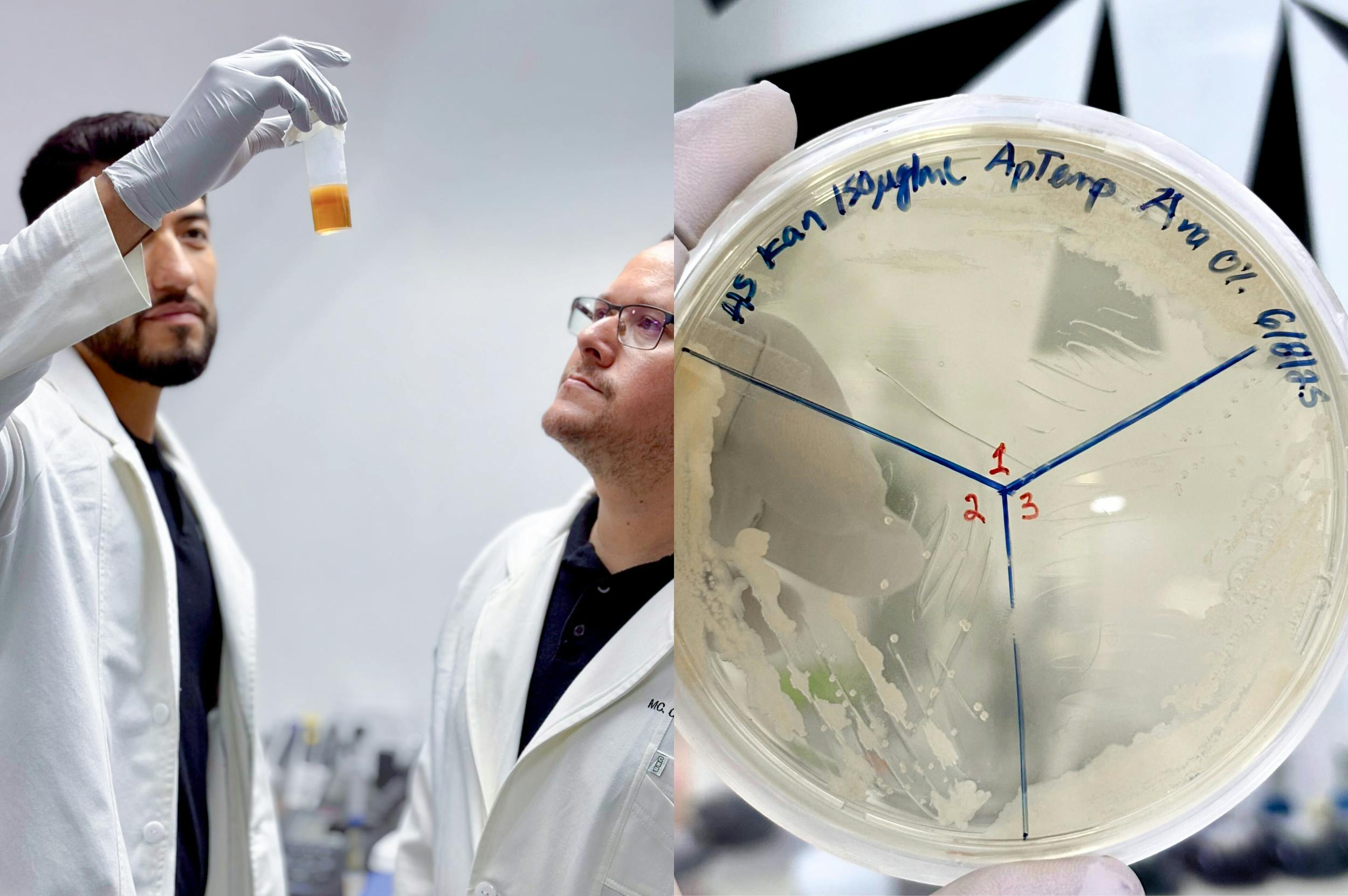
Innovation rarely begins on a stage. It begins in quiet rooms, at benches lit by microscopes, where small teams make precise choices that change the pace of discovery. For Polybion, that place is Piedras Pintas Biofoundry, our genetic R&D lab in Ensenada, Mexico. After unveiling the lab’s new chapter, we’re sharing one of the outcomes born within it: Terra, a genetically improved, confined‑use bacterial strain designed to accelerate growth and improve the performance of Celium™ - Premium Cultivated Cellulose from the inside out.
The bottleneck we chose to solve
In cultivated cellulose, productivity and consistency are strategic levers. Historically, attempts to speed up bacterial cellulose focused on the obvious end of the pipeline; pushing more monomers (“more bricks”) into the synthesis step, or encoding pigments to color the material during growth. We took a different path.
Instead of adding more bricks, Terra improves the masons. We intervened upstream in core metabolism, not downstream in cellulose synthesis. By giving the cell better internal tools to manage energy, oxygen handling, and detox pathways, we built a stronger biological chassis that works faster and more reliably across conditions.
Think of it as giving the organism a way to make its own “vitamins”, the molecular cofactors it needs to perform at its best. The result is not just more output, but a smarter route to output.
The invention at a glance
What it is: A genetically improved strain producing Celium™ - Premium Cultivated Cellulose that overexpresses a central metabolic cofactor (call it a molecular “M”) involved in energy generation, oxygen transport chemistry, and cellular detox.
What it does: Strengthens the cell’s baseline metabolism so it can grow faster, divide more, and fabricate denser cellulose pellicles under comparable conditions.
What’s protected: The patent covers the modified strain(s) and describes representative use conditions aligned with our process. Terra is not a single strain but a series, versions tuned for when and how the trait is expressed.
What changes in practice
Under matched conditions, the improved metabolism shortens maturation time for a typical bacterial cellulose pellicle from ~20 days to ~13 days (≈35% faster) while increasing pellicle density. In manufacturing terms, higher density means fewer thin spots and more usable area per sheet, value captured in both yield and downstream finishing.
This is not spectacle science; it is science that scales. Faster cycles and denser pellicles are two of the most direct ways to increase output and stabilize quality in cultivated materials.
“We didn’t just change our workflow, we changed our pace of discovery. Precision got easier. The rhythm picked up.” — José Manuel Aguilar, CSO
Platform, not one‑off: canonizing a non‑canonical organism
Industrial biology often relies on canonical organisms like E. coli or yeast, whose genetics and behaviors are deeply mapped. Bacterial‑cellulose producers are non‑canonical by comparison. Part of our work at Piedras Pintas is to canonize our strain, to make it predictable, tunable, and robust for engineering.
Terra is a platform step. By reinforcing baseline metabolism first, we can layer additional traits, structure, color pathways, stress‑response tuning without collapsing performance. In other words, a better chassis withstands more genetic “payload” without paying for it in productivity.
Piedras Pintas Biofoundry: The team behind Terra
Small teams, strong will. Terra is the product of a focused group combining scientific rigor with industrial pragmatism:
Axel Gómez‑Ortigoza — Co-CEO & CTO
Strategic direction and technology leadership. Framed the productivity‑first approach and the long‑term platform vision.
José Manuel “Chema” Aguilar — CSO
Genetic strategy and scientific direction. Designed the metabolic intervention “from bricks to masons” and led the R&D program.
César Ortiz Alcaraz — Experimental Design Lead
Established transformation parameters and experimental baselines using model proteins, providing the protocol foundation for new strains.
“With just four people, creativity and commitment matched what large groups pursue.”
Jorge Hernández — Genetic Engineering Scientist
Executed the genetic transformation, tested the new strain’s behavior, and co‑defined optimal operating conditions.
“Turning a modification into a real improvement demands exhaustive, careful work.”
Rafael García — Material Characterization Scientist
Led characterization: growth kinetics, cellulose production, and material properties—quantifying Terra’s biotechnological impact.
“This patent proves our potential to turn ideas into science with real impact.”
Behind every result is a dialogue: “design, execution, validation” repeated until the biology agrees.
Why this matters
- For materials: Shorter cycles and denser pellicles translate to higher output and more stable performance for Celium™ - Premium Cultivated Cellulose
- For engineering: A reinforced metabolic baseline allows stacking future traits without sacrificing productivity.
- For industry: It demonstrates how targeted genetic design can reset constraints in biofabrication.
Terra is a statement about how we innovate: by building capacity within the organism so that everything after becomes easier, faster, and more precise.
What’s next
This is our latest published patent originating from the upgraded Piedras Pintas Biofoundry. Additional filings are in the pipeline and progressing through the relevant jurisdictions. The work continues: refining Terra variants, layering new capabilities, and translating lab precision into scalable manufacturing, responsibly and step by step.
From Piedras Pintas Biofoundry, we’re shaping a new chapter for cultivated materials from within.